


Biography of Fei-Fei Li: The Woman Who Taught Machines to See
What if one dataset could change the entire future of artificial intelligence?
This is the story of Fei-Fei Li—the woman who didn’t just study AI, but fundamentally transformed how machines understand the world.
This is the Biography of Fei-Fei Li, a story that defines innovation, resilience, and the future of artificial intelligence.
Fei-Fei Li is not just a story of artificial intelligence—it is a story of resilience, vision, and determination. From humble beginnings as an immigrant teenager working in a family business to becoming one of the most influential figures in modern AI, her journey reflects what happens when curiosity meets persistence.
Table of Contents
- 1. Early Life of Fei-Fei Li: Background and Struggles
- 2. Education: The Curiosity That Changed Everything
- 3. Career Beginnings: Recognizing the Real Problem
- 4. Real-World Impact: How ImageNet Changed Industries
- 5. Leadership and Vision: From Researcher to Global Leader
- 6. Human-Centered AI: Technology with Purpose
- 7. AI4ALL and Diversity: Expanding Opportunities
- 8. Challenges and Criticism: Facing Reality
- 9. 📅 Timeline of Major Events
- 10. 💬 10 Famous Quotes with Meaning
- 11. 🎯 Fun Facts About Fei-Fei Li
- 12. Conclusion on the Biography of Fei-Fei Li
Early Life of Fei-Fei Li: Background and Struggles
Fei-Fei Li was born in 1976 in Beijing, China, into a family that placed a strong emphasis on education, discipline, and intellectual growth. Her early childhood was shaped by structured learning environments and a culture that valued persistence and academic excellence. Like many children growing up in China during that period, she was encouraged to think critically and work hard, but her journey would soon take a dramatically different path.
At the age of 16, her life changed completely when her family decided to immigrate to the United States. This was not a move driven by comfort, but by hope—the hope of better opportunities, education, and a more stable future. However, the transition was far from easy.
Arriving in a new country meant starting from zero. She had to adapt to a completely unfamiliar environment, including a new language, a different education system, and a culture that felt foreign in every way. While many teenagers struggle with identity and academics, she faced the additional burden of helping her family survive financially.
Her parents opened a small dry-cleaning business, and Fei-Fei Li spent long hours working there after school. These were not occasional efforts; they were part of her daily routine. Balancing schoolwork with physical labor required discipline and sacrifice. She often had to study late at night, managing exhaustion while staying committed to her goals.
These experiences shaped her deeply. They taught her resilience, time management, and the importance of perseverance under pressure. More importantly, they gave her a grounded understanding of struggle—something that would later influence her approach to leadership and innovation.
Rather than being discouraged by these challenges, she developed a mindset focused on long-term success. She understood that progress might be slow, but consistency would eventually lead to results.
👉 This phase of her life did not define her limitations—it defined her strength.
This part of the biography of Fei-Fei Li shows how early struggles shaped her strong mindset and determination.
Education: The Curiosity That Changed Everything
Fei-Fei Li’s academic journey began at Princeton University, where she chose to study physics. At first glance, physics might seem unrelated to artificial intelligence, but it provided her with a strong analytical foundation. It trained her to think logically, solve complex problems, and approach challenges with precision.
However, during her time at Princeton, she began to feel that physics alone could not answer the questions that fascinated her the most. She was not just interested in how the physical world functioned—she was deeply curious about intelligence itself.
She began asking questions that went beyond traditional scientific boundaries. How does the human brain recognize objects instantly? How do we interpret visual information so effortlessly? And most importantly, could machines ever develop similar capabilities?
These questions led her to shift her focus toward artificial intelligence.
After completing her undergraduate degree, she pursued a PhD at the California Institute of Technology (Caltech). There, she specialized in computer vision and cognitive neuroscience, combining insights from both fields to understand how perception works.
This interdisciplinary approach was not common at the time. Many researchers focused either on algorithms or neuroscience, but Fei-Fei Li chose to bridge the gap between the two. She believed that to build intelligent machines, one must first understand human intelligence.
Her research explored how visual recognition works in the brain and how similar mechanisms could be replicated in machines. This perspective gave her a unique advantage—she was not just building systems; she was trying to understand the essence of perception.
👉 This combination of curiosity and technical depth laid the foundation for her future breakthrough.
This phase of the biography of Fei-Fei Li highlights how curiosity shaped her journey toward artificial intelligence.
The life story of Fei-Fei Li clearly reflects how curiosity led her toward groundbreaking discoveries in AI.
Career Beginnings: Recognizing the Real Problem
After completing her PhD, Fei-Fei Li began her professional journey in academia, eventually joining Stanford University as a professor. At the time, artificial intelligence was still a developing field, and progress in computer vision was limited.
Machines struggled with even the simplest visual recognition tasks. Identifying objects in images, distinguishing between categories, or understanding complex scenes was extremely difficult. Despite ongoing research, improvements were incremental rather than transformative.
Most researchers believed that the solution lay in developing better algorithms. There was a strong focus on refining models, improving computational efficiency, and optimizing existing techniques.
However, Fei-Fei Li observed something that others overlooked.
She realized that the core problem was not just algorithmic—it was fundamentally about data. Machines were being trained on small datasets with limited examples, which restricted their ability to learn effectively.
To understand this, she compared machine learning to human learning. Humans learn through exposure. A child recognizes objects because they have seen thousands of variations over time. Machines, on the other hand, were being trained on datasets that were too small to capture real-world complexity.
👉 The issue was not intelligence—it was experience.
This insight shifted her focus entirely. Instead of concentrating only on improving algorithms, she began exploring how to provide machines with large-scale, structured data that could simulate real-world exposure.
This decision marked a turning point in her career. It set the stage for a project that would not only define her legacy but also transform the entire field of artificial intelligence.
👉 She was no longer just improving AI—she was redefining how it learns.
The life story of Fei-Fei Li took a major turn when she identified data as the core problem in AI development.
ImageNet: The Breakthrough That Changed AI
The turning point in the success story of Fei-Fei Li came with a bold and unconventional idea—ImageNet.
At its core, the idea sounded simple: create a massive dataset of labeled images so machines could learn to recognize objects the way humans do. But in reality, this was one of the most ambitious projects ever attempted in artificial intelligence at the time.
To understand the magnitude, consider this: AI systems before ImageNet were trained on datasets containing thousands of images. Fei-Fei Li envisioned a dataset with millions of images across thousands of categories.
This required solving multiple challenges simultaneously.
First, the scale itself was overwhelming. Collecting millions of images from the internet was only the beginning. Each image needed to be accurately labeled, categorized, and verified. This meant coordinating large numbers of human annotators, managing data pipelines, and ensuring consistency across the dataset.
Second, there was skepticism from the research community. Many experts believed that simply increasing data size would not lead to major breakthroughs. The prevailing belief was that algorithmic improvements mattered more than data scale.
Third, there were resource constraints. Funding for such a large and unconventional project was difficult to secure. It was not an obvious success story in the making—it was a high-risk experiment.
Despite these obstacles, Fei-Fei Li remained committed.
She believed that data was the missing piece in artificial intelligence. Machines could not learn effectively without exposure to the complexity of the real world, and ImageNet was designed to provide exactly that.
After years of effort, the project reached a defining moment in 2012. A deep learning model trained on ImageNet dramatically outperformed all previous methods in image recognition tasks. The improvement was not incremental—it was revolutionary.
This breakthrough proved that large-scale data combined with deep neural networks could unlock unprecedented performance.
👉 ImageNet did not just improve AI—it transformed the direction of the entire field.
From that point onward, data-driven deep learning became the dominant approach in artificial intelligence, influencing research, industry, and real-world applications across the globe.
This moment became the defining point in the success story of Fei-Fei Li, establishing her as a pioneer in artificial intelligence.
This milestone became central to the biography of Fei-Fei Li and marked the beginning of the modern AI revolution.
Real-World Impact: How ImageNet Changed Industries
The success of ImageNet did not remain confined to academic research—it quickly translated into real-world impact across multiple industries.
Before this breakthrough, artificial intelligence struggled to move beyond controlled environments. Systems lacked the ability to interpret complex visual data, limiting their practical applications. But once ImageNet demonstrated the power of large-scale learning, everything began to change.
In the automotive industry, self-driving car systems improved significantly. Vehicles could now detect pedestrians, traffic signs, and obstacles with greater accuracy. This advancement brought autonomous driving closer to reality.
In healthcare, AI began to assist in medical imaging. Systems trained on large datasets could analyze X-rays, MRIs, and CT scans, helping doctors detect diseases earlier and more accurately. This opened new possibilities for diagnostics and treatment planning.
Facial recognition technology also advanced rapidly. Security systems, smartphones, and surveillance tools became more reliable, although this also introduced new ethical concerns.
Retail and e-commerce platforms started using visual AI to recommend products based on images. Users could search for items using photos instead of text, creating a more intuitive experience.
These developments were all built on a single principle:
👉 The more data machines see, the better they learn.
Fei-Fei Li’s work demonstrated that artificial intelligence could scale effectively when supported by the right data infrastructure. Her contribution was not limited to a single innovation—it created a foundation upon which countless technologies were built.
👉 ImageNet became the backbone of modern computer vision.
The biography of Fei-Fei Li demonstrates how one idea can influence multiple industries globally.
Leadership and Vision: From Researcher to Global Leader
Following the success of ImageNet, Fei-Fei Li transitioned into a leadership role that extended far beyond academic research. She became one of the most influential voices in artificial intelligence, shaping both technological progress and the broader conversation around its impact.
At Stanford University, she served as a professor and later as the Director of the Stanford Artificial Intelligence Lab. In this role, she guided research, mentored students, and influenced the next generation of AI scientists.
Her career also expanded into industry when she joined Google Cloud as the Chief Scientist of AI. Here, she worked on integrating artificial intelligence into large-scale cloud systems, helping businesses leverage AI for real-world applications.
What makes her leadership unique is her balanced perspective.
While many leaders focus purely on performance and innovation, Fei-Fei Li emphasizes responsibility. She consistently raises questions about how AI should be developed and used.
👉 What problems should AI solve?
👉 Who benefits from AI systems?
👉 How do we ensure fairness and accountability?
These questions define her leadership philosophy.
She does not view AI as just a technological advancement—it is a societal force that must be guided carefully. Her approach combines technical excellence with ethical awareness, making her one of the most respected leaders in the field.
👉 She is not just building AI—she is shaping its direction.
The biography of Fei-Fei Li also reflects her leadership in shaping ethical AI globally.
The life story of Fei-Fei Li also highlights her role as a global leader in ethical AI development.
Human-Centered AI: Technology with Purpose
As artificial intelligence began to scale rapidly after the ImageNet breakthrough, a new set of concerns emerged. AI was no longer just a research topic—it was becoming deeply integrated into everyday life. From recommendation systems to surveillance tools, its influence was expanding at an unprecedented pace.
Fei-Fei Li recognized early that this growth came with serious responsibilities.
She introduced and strongly advocated the concept of human-centered AI. This philosophy focuses on ensuring that artificial intelligence is designed to serve people, rather than replace or control them.
Her perspective was shaped by both her technical expertise and her life experiences. Having faced challenges as an immigrant, she understood how systems can unintentionally exclude or disadvantage certain groups. She realized that if AI systems were trained on biased data or built without diverse perspectives, they could reinforce inequalities.
Human-centered AI emphasizes:
- Fairness and inclusivity in algorithms
- Transparency in decision-making systems
- Accountability for developers and organizations
- Alignment with human values and societal needs
She has consistently argued that AI is not just a technical field—it is deeply connected to ethics, sociology, and policy. Technology does not exist in isolation; it reflects the intentions and biases of those who create it.
👉 Her message is clear: the future of AI must be built responsibly, with humans at the center of every decision.
This shift in thinking has influenced not only academic research but also industry practices, encouraging organizations worldwide to adopt more ethical approaches to AI development.

AI4ALL and Diversity: Expanding Opportunities
One of Fei-Fei Li’s most impactful contributions beyond technical innovation is her effort to make artificial intelligence more inclusive.
She co-founded AI4ALL, a nonprofit organization dedicated to increasing diversity in the field of AI. This initiative was born out of a critical realization:
👉 The people who build AI systems shape how those systems behave.
If AI is developed by a narrow group of individuals, it risks reflecting limited perspectives. This can lead to biased outcomes, lack of representation, and unintended harm.
AI4ALL aims to address this problem at its root by:
- Providing AI education to underrepresented students
- Creating opportunities for women and minorities in technology
- Building a more inclusive pipeline of future AI leaders
Through workshops, mentorship programs, and educational initiatives, AI4ALL empowers young individuals to explore careers in artificial intelligence. It not only teaches technical skills but also emphasizes ethical responsibility and social awareness.
Fei-Fei Li believes that diversity is not just a moral requirement—it is a practical necessity. Diverse teams bring different perspectives, which leads to better problem-solving and more robust systems.
👉 Inclusion drives innovation.
Her work with AI4ALL has had a global impact, inspiring similar initiatives and encouraging organizations to rethink how they approach hiring and development in AI.
By expanding access to education and opportunity, she is ensuring that the future of artificial intelligence is shaped by a broader and more representative group of people.
This initiative adds another important chapter to the success story of Fei-Fei Li, focusing on inclusivity in technology.
Challenges and Criticism: Facing Reality
Despite her groundbreaking contributions, Fei-Fei Li’s journey has not been without challenges and criticism.
One of the earliest obstacles she faced was skepticism surrounding ImageNet. Many researchers questioned whether building such a large dataset was necessary or practical. At the time, the idea seemed excessive, and the effort required appeared disproportionate to the expected outcomes.
However, the success of ImageNet eventually proved these doubts wrong.
As AI technology advanced, new challenges emerged. The rapid growth of artificial intelligence raised concerns about privacy, surveillance, and algorithmic bias. Systems trained on biased data could produce unfair or inaccurate results, leading to broader societal implications.
Fei-Fei Li has been vocal about these issues, advocating for responsible development and ethical guidelines. However, balancing innovation with regulation is complex, especially in a fast-moving industry.
Another challenge has been navigating roles in both academia and industry. Working with large technology companies while promoting ethical AI requires careful decision-making and transparency.
Despite these challenges, she has maintained a consistent stance:
👉 Innovation must not come at the cost of responsibility.
Her ability to address criticism while continuing to push boundaries has strengthened her reputation as both a scientist and a leader.
📅 Timeline of Major Events
- 1976 – Born in Beijing, China
- 1990s – Immigrates to the United States with family
- 1999 – Graduates from Princeton University (Physics)
- 2005 – Completes PhD at Caltech (AI & Neuroscience)
- 2009 – Launches ImageNet project
- 2012 – ImageNet breakthrough triggers deep learning revolution
- 2017 – Becomes Chief Scientist at Google Cloud AI
- 2018 – Co-founds AI4ALL
- 2020+ – Leads global conversation on ethical AI and human-centered AI
💬 10 Famous Quotes with Meaning
- “AI is made by humans, for humans.”
→ Technology must always serve people, not replace them. - “Diversity drives innovation.”
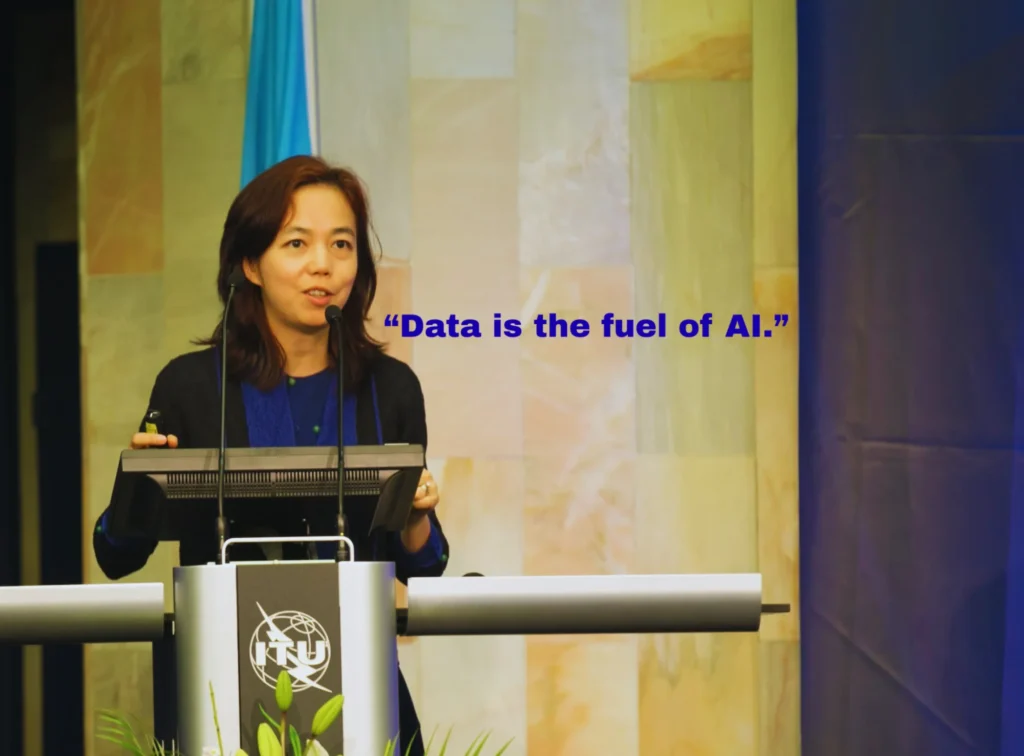
→ Different perspectives lead to better AI systems. - “Data is the fuel of AI.”
→ Without data, AI cannot learn effectively. - “Technology must reflect humanity.”
→ AI should mirror human values and ethics. - “Curiosity leads to discovery.”
→ Innovation begins with asking questions. - “Failure is part of progress.”
→ ImageNet itself took years to succeed. - “AI should empower humans.”
→ Enhancement, not replacement. - “Learning never stops.”
→ Continuous growth mindset. - “Vision creates impact.”
→ Big ideas change industries. - “Ethics must guide technology.”
→ Responsibility is non-negotiable.
🎯 Fun Facts About Fei-Fei Li
- Worked in a dry-cleaning shop during teenage years
- Built one of the largest datasets in AI history (ImageNet)
- Strong advocate for women in STEM and diversity in AI
- Combines neuroscience + AI thinking
- Helped trigger the modern AI revolution (2012 breakthrough)
- Believes storytelling is essential for explaining AI
- One of the few leaders balancing tech + ethics together
Conclusion on the Biography of Fei-Fei Li
The biography of Fei-Fei Li is more than a story of technological achievement—it is a story of vision, resilience, and purpose.
From her early days as an immigrant working in a family business to becoming one of the most influential figures in artificial intelligence, her journey reflects the power of determination and long-term thinking. She did not simply follow existing paths; she created new ones.
Her work on ImageNet transformed how machines learn, but her impact goes far beyond that. She has redefined how we think about artificial intelligence—not just as a tool, but as a responsibility.
Through her leadership, advocacy, and initiatives like AI4ALL, she has ensured that the future of AI is not only innovative but also inclusive and ethical.
👉 Her legacy is not just about teaching machines to see—it is about helping humanity see the bigger picture.
As artificial intelligence continues to evolve, her influence will remain a guiding force in shaping a future where technology serves people, rather than the other way around.
Overall, the biography of Fei-Fei Li reflects a journey of vision, persistence, and global impact.